
DeepSeek V4.1 Flash vs GLM 5.3 Flash: I Made Them Fight
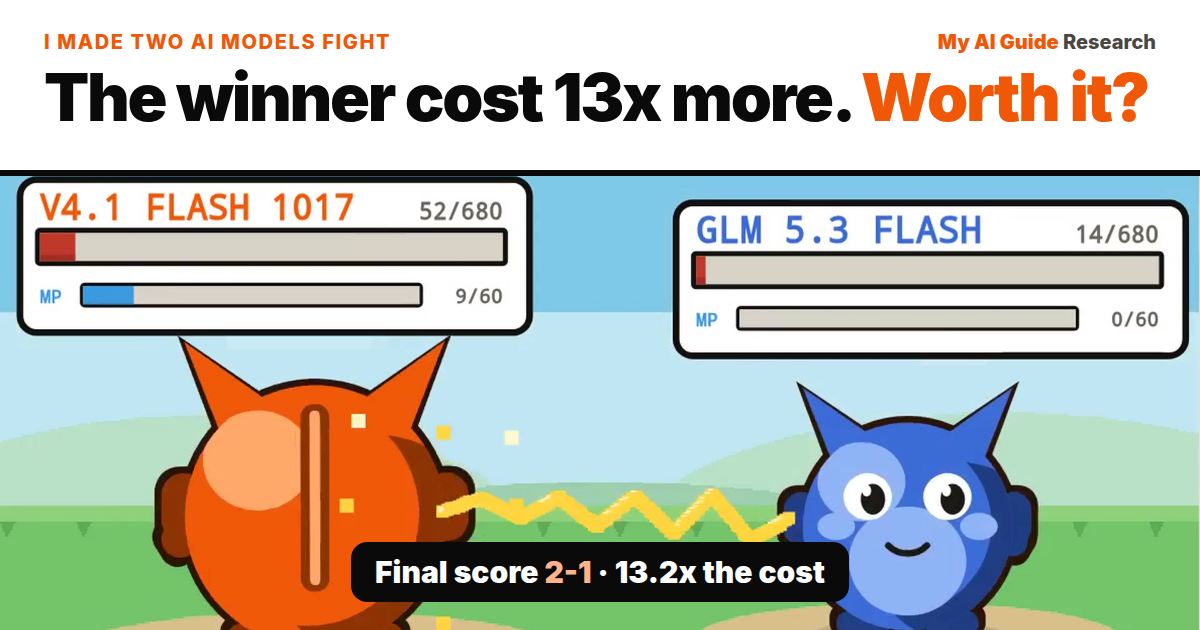
Three real games, one fair setup. The winner thought 8.3 times more per move and cost 13.2 times more.

Harsh Desai
TL;DR
- DeepSeek V4.1 Flash beat GLM 5.3 Flash 2-1 in three fair games of Sillimon, a turn-based monster duel I built to test AI models.
- DeepSeek's bill was 13.2 times bigger ($0.4582 against $0.0348), even though both makers list the same $0.15 input price.
- The gap came from thinking: DeepSeek wrote about 13,200 thinking tokens per move against GLM's 1,600, which is 8.3 times more.
- DeepSeek also took 2.4 times longer per move: 81.8 seconds against 33.6 seconds.
- Choose GLM 5.3 Flash by default for speed and cost; choose DeepSeek V4.1 Flash when one careful decision is worth the wait.
What's Inside This Guide
- The Result in 30 Seconds
- What I Tested
- The Three Fights
- The Numbers Side by Side
- The Price Tag vs the Real Bill
- Which Should You Use?
- How to Read This Result
- Run Your Own Fair Test
- Frequently Asked Questions
The Result in 30 Seconds
DeepSeek V4.1 Flash won two of three games and GLM 5.3 Flash won one. Every game was close: the winners finished with 34, 49 and 30 health out of 680.
The win was expensive. Both are thinking models: before each answer they write private reasoning, and you pay for those words. A token is a small piece of text, roughly three quarters of a word, and DeepSeek wrote far more of them, so it cost 13.2 times more to run.
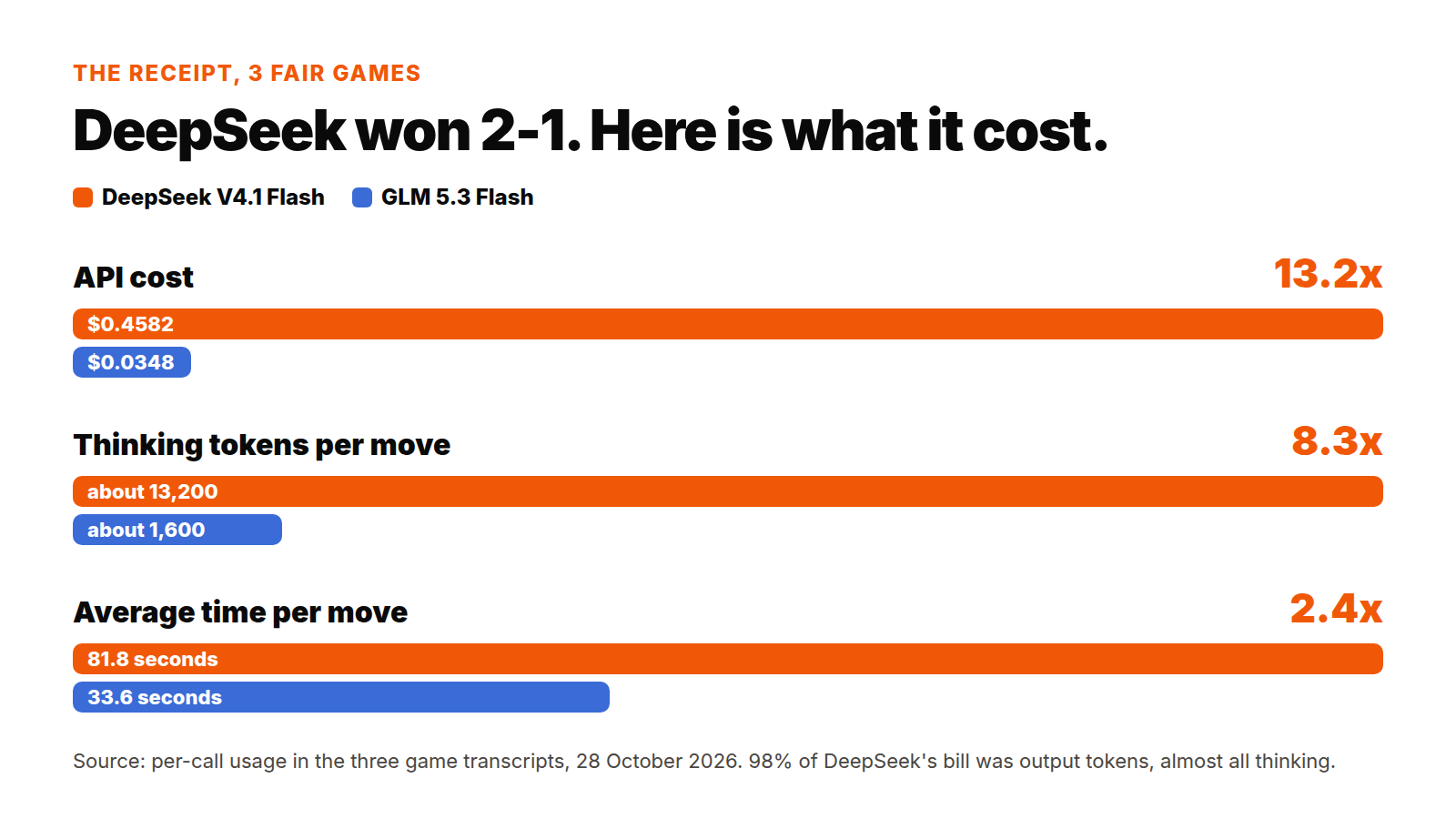
In builder terms, DeepSeek cost about $8.18 for every 1,000 moves and GLM about $0.62. An app making 1,000 decisions a day would pay about $245 a month with DeepSeek and about $19 with GLM.
Each fight below has a full replay with the thinking waits cut out, so you can check every move yourself.
What I Tested
I tested two cheap, fast thinking models in a game I built, with everything pinned so the only difference was the decisions. I reached both through OpenRouter, a service that gives one API (a way for software to talk to a model) for hundreds of AI models. Here is what each model is, how the game works and how I kept it fair.
What Is DeepSeek V4.1 Flash?
DeepSeek V4.1 Flash is a fast, low-cost thinking model from the Chinese AI lab DeepSeek. I tested the version dated 17 October 2026, DeepSeek V4.1 Flash 1017, which reads about one million tokens at once and thinks before every answer unless you switch thinking off.
The DeepSeek tool page on My AI Guide covers its free chat app, open weights (model files anyone can download) and API.
What Is GLM 5.3 Flash?
GLM 5.3 Flash is a fast, low-cost thinking model from Z.ai, the international brand of the Chinese lab Zhipu AI. It also reads about one million tokens, understands images as well as text, and always thinks: its thinking stayed on with every one of the 38 companies (hosts) that serve it on OpenRouter, which I checked in October.
The Z.ai tool page on My AI Guide covers its chat app, coding plans and API pricing.
What Is Sillimon?
Sillimon is a turn-based monster duel I built to compare AI models in a real game instead of trusting launch charts. Two models each control an identical monster, both pick a move in secret every turn, and the game decides what happens. Every rule, setting and measurement is in How Sillimon Works.
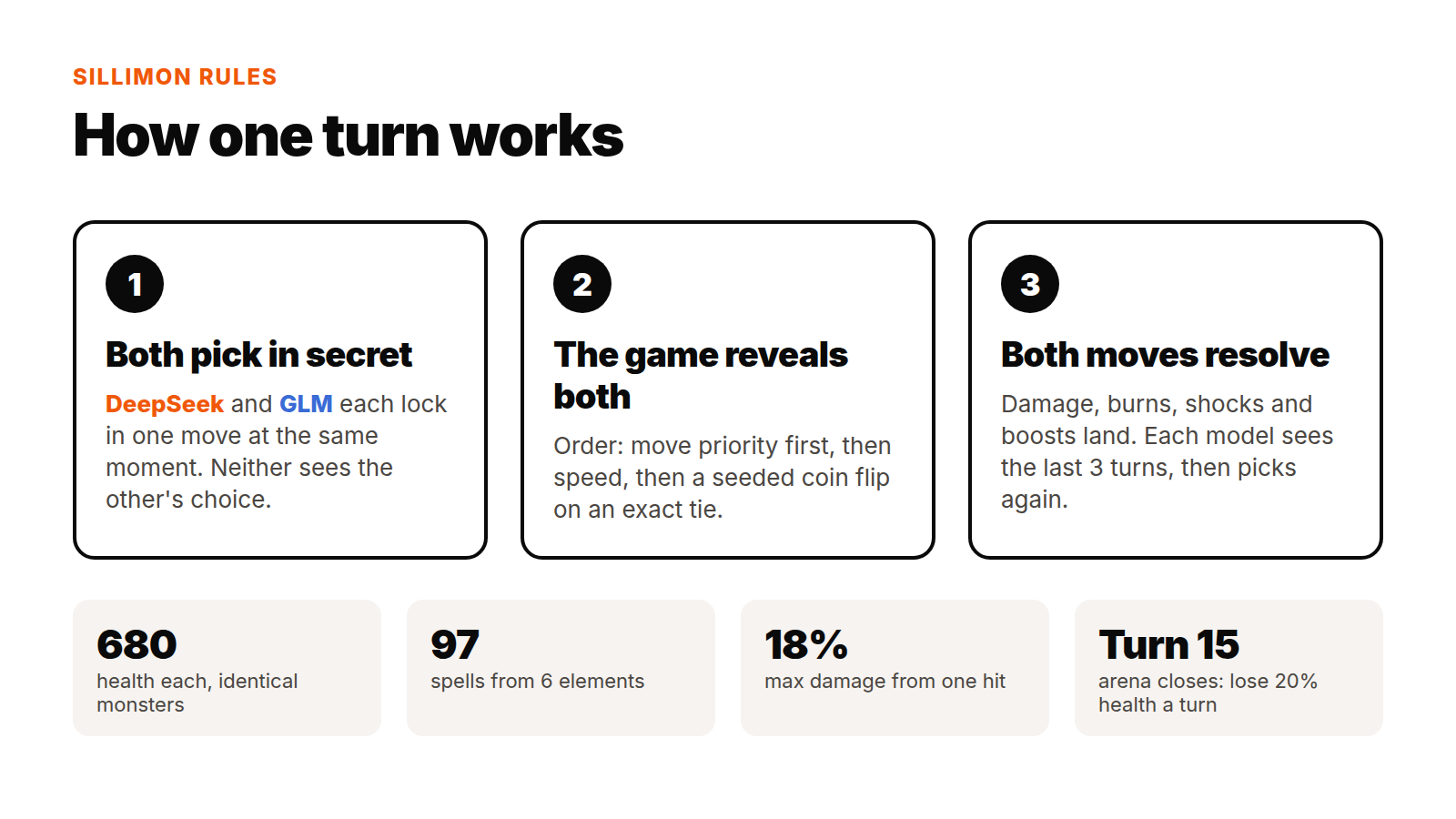
Each monster starts with 680 health, some mana (the energy every spell costs) and the same spellbook of fire, lightning, ice, water, mind and stone spells. Both also have physical moves, such as a jab or a guard, and boosts that raise defence or speed. The only difference between the two sides is the decisions.
From turn 15 the arena starts to close, and both monsters lose a fifth of their health every turn. That is why every game ended between turns 18 and 20. Each model sees only "you" and "opponent", never a model name, so neither can favour itself.
How I Kept It Fair
Both models got the same hosts, the same precision (how exactly the model's numbers are stored), the same settings and the same instructions. A model on OpenRouter can be served by several companies (hosts), and the host changes speed, price and sometimes quality, so I pinned them.
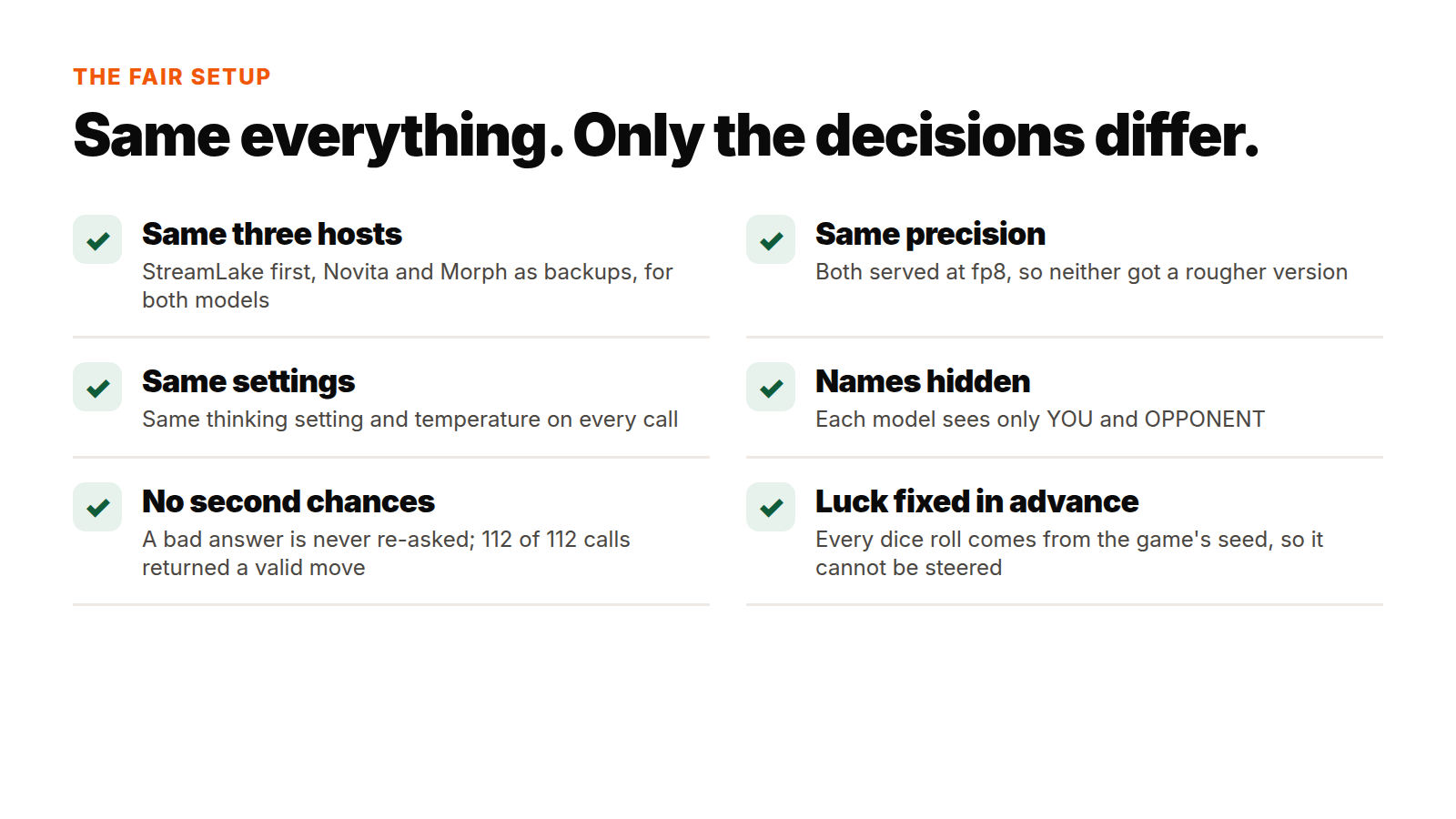
| Setting | Both models |
|---|---|
| Hosts, in order | StreamLake first, Novita and Morph as backups |
| Precision | fp8 (8-bit numbers inside the model) |
| Thinking effort | high |
| Temperature | 0 (the least random setting) |
| Output cap | none sent |
| Second chances | none: all 112 calls returned a valid move |
| Dice rolls | fixed in advance for each game, so luck could not be retried |
I threw out an earlier series from 27 October because it was unfair: GLM was unpinned and mostly ran at a lower precision (fp4, 4-bit numbers). The fair series ran on 28 October, three games at once on three separate machines. Every call, token count, cost and move was saved, and every number in this article comes from those records.
The Three Fights
DeepSeek won the first two fights and GLM won the third. Each one was decided in the last three turns, after the closing arena had pushed both monsters close to zero.
Fight 1: DeepSeek Wins on Turn 20
DeepSeek won on turn 20 with 34 health left. GLM defended well, and the finish came down to a wasted spell.
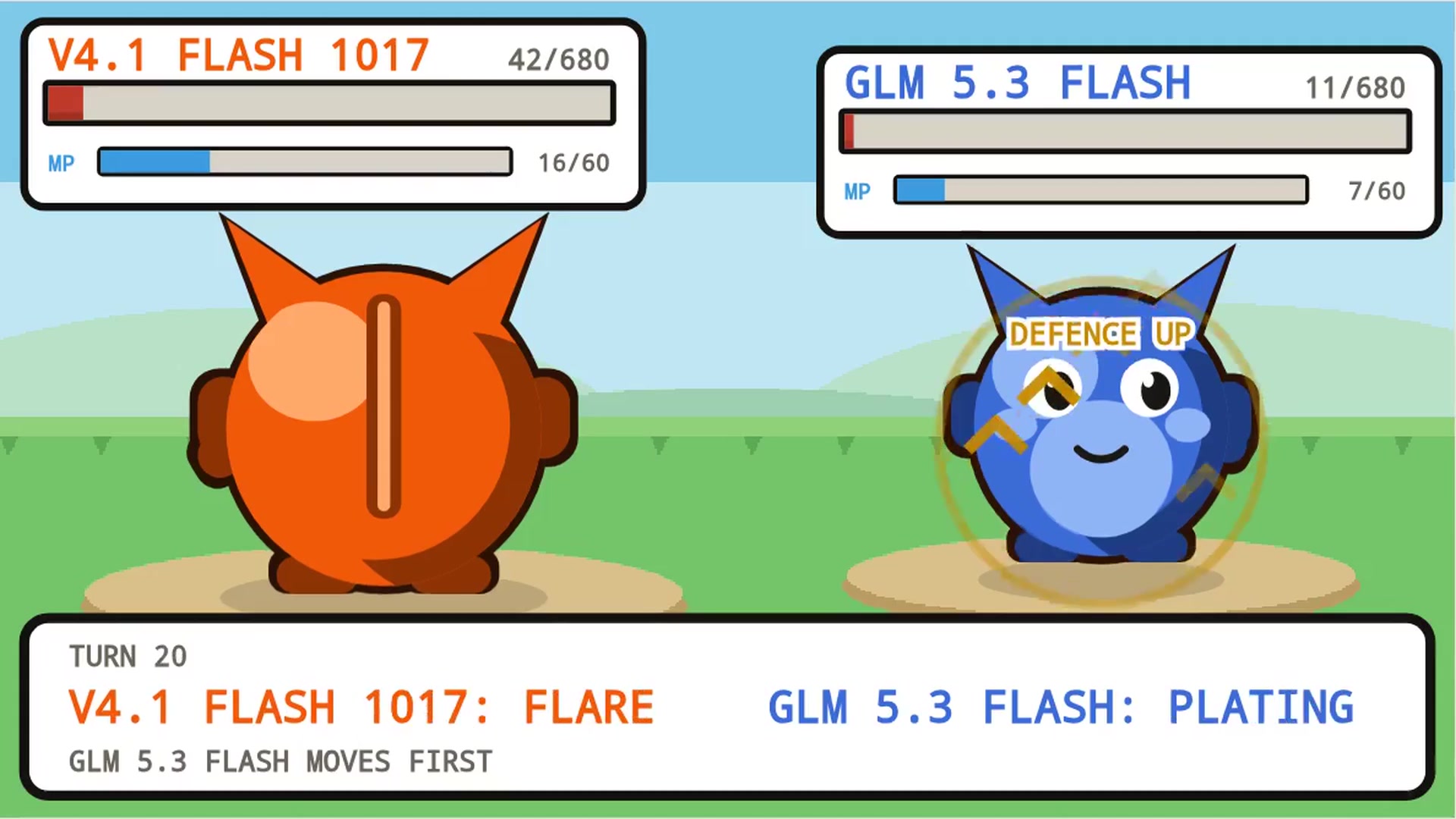
On turn 18, GLM raised its guard with 14 health left, reasoning: "Only Guard lets me survive their hit, burn, and arena drain." On turn 19, GLM cast Spark, a spell whose shock drains mana, and it resolved first. DeepSeek's big Flashburn spell was left below its mana cost and fizzled (a fizzle is a wasted spell, which is different from a miss).
On turn 20 DeepSeek switched to Flare, a spell that always hits, and won. Over the fight, DeepSeek dealt 558 direct damage to GLM's 381. Three of DeepSeek's spells failed to land (one miss, two fizzles), against four of GLM's (one miss, three fizzles).
Fight 2: DeepSeek Wins Without a Single Miss
DeepSeek won on turn 18 with 49 health left, and every one of its 12 spells landed. This was its cleanest game.
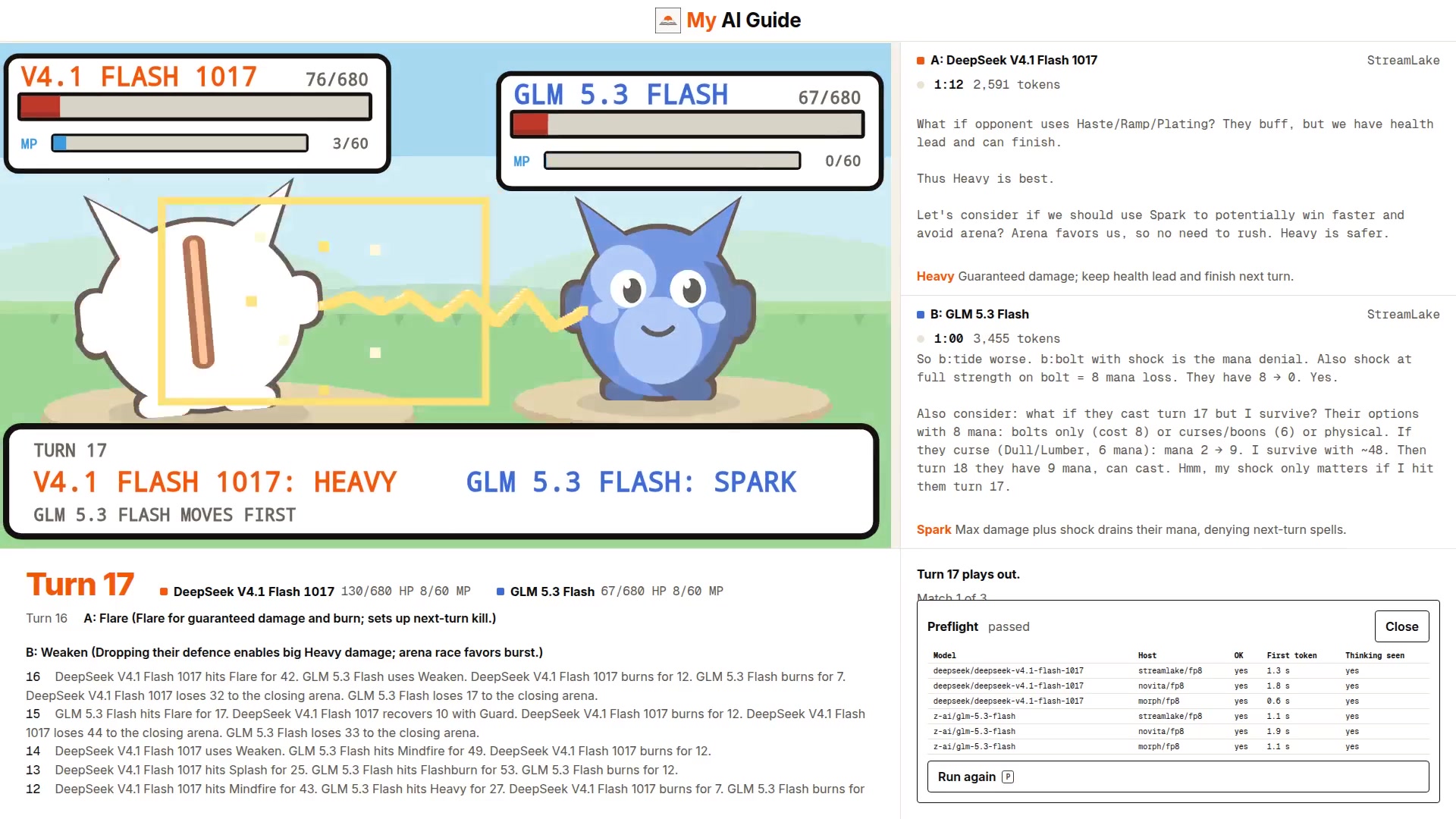
The ending was a race. On turn 17, GLM cast Spark, reasoning that its "shock drains their mana, denying next-turn spells." On turn 18, GLM raised its defence with a boost called Plating, writing that "Opponent's Heavy would kill me."
DeepSeek cast Flashburn instead, which it calculated would deal 53 damage, and it dealt exactly that to finish GLM. Across the fight, DeepSeek dealt 584 direct damage to GLM's 429.
Fight 3: GLM Wins by Moving First
GLM won on turn 18 with 30 health left, using a plan that worked across two turns.
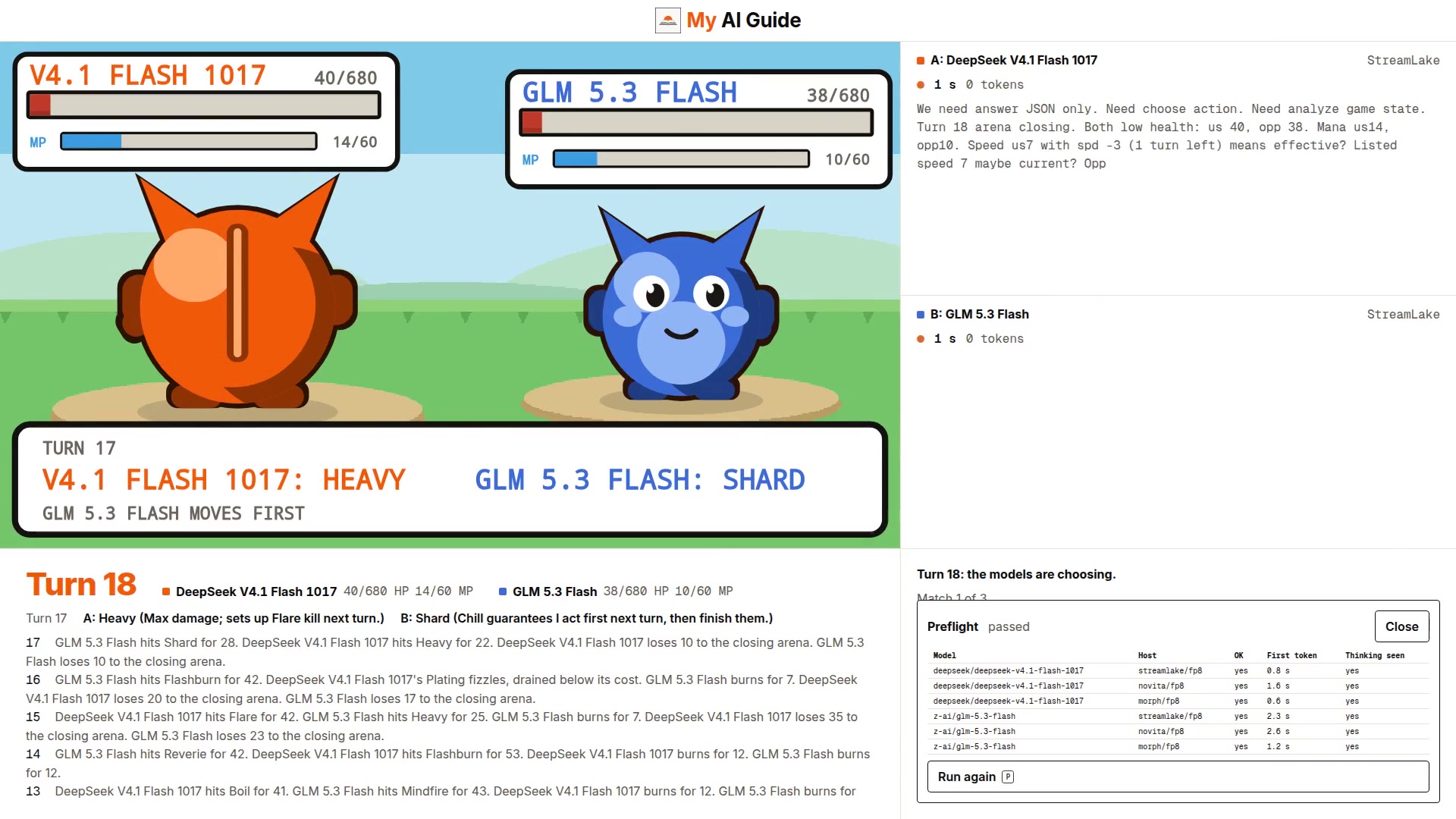
On turn 17, GLM cast Shard, a spell that chills (slows) the opponent, reasoning: "Chill guarantees I act first next turn, then finish them." On turn 18, with DeepSeek on 40 health, GLM acted first and cast Flashburn for 42 damage. Its finishing blow landed before DeepSeek's planned Spark, which had a 75 percent chance to hit.
GLM out-damaged DeepSeek in this game, 566 to 494. It was also the slowest game: one GLM call stalled on its first host for the full 10-minute limit, and the backup host answered in 198 seconds.
The Numbers Side by Side
DeepSeek won more games, hit harder and landed more of its spells. GLM was far cheaper and much faster.
| Measure (3 fair games) | DeepSeek V4.1 Flash | GLM 5.3 Flash |
|---|---|---|
| Games won | 2 | 1 |
| Direct damage dealt | 1,636 | 1,376 |
| Spells cast | 38 | 38 |
| Spells missed (failed the accuracy roll) | 1 | 2 |
| Spells fizzled (mana drained) | 3 | 4 |
| Valid moves returned | 56 of 56 | 56 of 56 |
| Thinking tokens per move | about 13,200 | about 1,600 |
| Average time per move | 81.8 seconds | 33.6 seconds |
| Longest single move | 313 seconds | 198 seconds |
| API cost, three games | $0.4582 | $0.0348 |
| Cost per 1,000 moves | about $8.18 | about $0.62 |
Both models cast exactly 38 spells. The difference was how often they landed and how hard they hit, so the extra thinking showed up as cleaner execution rather than a different style of play.
The extra thinking also explains the waiting. In a live app, a reply in about 30 seconds feels slow, and a reply in about 80 seconds feels broken.
The Price Tag vs the Real Bill
On paper the two models cost almost the same. Both makers list $0.15 per million input tokens, and DeepSeek's output price is only 1.2 times GLM's. The real bill was 13.2 times bigger.
| Price per million tokens | DeepSeek V4.1 Flash | GLM 5.3 Flash | Ratio |
|---|---|---|---|
| Official input price from the maker, DeepSeek API off-peak and Z.ai API (11 Nov 2026) | $0.15 | $0.15 | 1.0x |
| Official output price from the maker, DeepSeek API off-peak and Z.ai API (11 Nov 2026) | $0.60 | $0.50 | 1.2x |
| OpenRouter listed input price, StreamLake fp8 (11 Nov 2026) | $0.111 | $0.089 | 1.2x |
| OpenRouter listed output price, StreamLake fp8 (11 Nov 2026) | $0.444 | $0.295 | 1.5x |
| Output price actually billed during the fights (28 Oct 2026) | about $0.61 | about $0.29 | 2.1x |
| Actual cost of the three fights | $0.4582 | $0.0348 | 13.2x |
Almost all of the gap is thinking. Output made up 98 percent of DeepSeek's bill, and 738,040 of its 739,391 output tokens were thinking. It paid about twice as much per output token and wrote about eight times more of them, and the two multiply.
Prices Move, Thinking Habits Stay
Prices change by host and by time of day. DeepSeek's own API charges double at peak hours ($0.30 input and $1.20 output per million tokens). On 11 November 2026, OpenRouter's hosts charged from $0.15 to $2.40 per million output tokens for DeepSeek V4.1 Flash 1017, and from $0.08 to $0.63 for GLM 5.3 Flash.
DeepSeek's billed price sat a little above today's StreamLake listing, because host prices move and three of its calls went to the backup host. The amount each model thinks is the part that stays, and you only learn it by testing.
How to Control the Thinking Bill
You control part of this bill with the thinking effort setting. On OpenRouter, you send a reasoning effort with each request, for example "reasoning": {"effort": "low"}, and both models accept six levels: minimal, low, medium, high, xhigh and max. DeepSeek can also switch thinking off completely; GLM always thinks.
Watch one trap: sending no setting at all is the most expensive choice. In a separate small test on 27 October, using one puzzle, both models thought more with no setting than at "high": DeepSeek 2.8 to 3.6 times more and GLM 1.3 to 2.7 times more, depending on the host.
So name the effort level in every request, pin your hosts, and measure cost per finished task.
Which Should You Use?
Choose GLM 5.3 Flash by default, and switch to DeepSeek V4.1 Flash when one careful decision is worth about 13 times the cost and more than twice the wait. Here is how that splits by job.
Choose GLM 5.3 Flash When
- People wait for the answer. Chatbots and apps, where it answered more than twice as fast.
- You make many calls. About $0.62 per 1,000 moves against $8.18 decides whether a product makes money.
- Your agent takes many steps. Every second and every cent multiplies across a long run.
- You want a first draft. Use GLM for the first pass and send only the hard cases to a heavier model.
Choose DeepSeek V4.1 Flash When
- Nobody is waiting. Overnight research, batch analysis and data cleaning, where a slow answer costs nothing.
- One wrong step ruins the job. Planning, tricky calculations and multi-step logic.
- You want a careful second opinion. Reviewing the work of a cheaper model.
- Volume is low. At a few hundred calls a day, even the bigger bill stays small.
How I Use Them
I used to compare models by price per token. Since this test, I compare them by cost per finished job: the price per token multiplied by how much the model thinks. I reach for the lighter thinker first and send only the hardest decisions to the heavier one.
If you are new to AI, start with GLM: quick answers while you learn, with a tiny bill. If you build apps, make GLM your everyday model and route the hard steps to DeepSeek. If you ship to production, run your own workload through both with pinned hosts before you choose.
How to Read This Result
This is a clear head-to-head: three fair games, one game type and one thinking level. Here is exactly what it covers, and what I am testing next.
- Three fair games. DeepSeek won 2-1, and every game was decided in the last three turns. A trial game earlier the same day went to GLM, so more games will sharpen the score.
- Thinking effort set to high. Both models ran at the same "high" level. A low-effort rematch will show how the cost gap and the result move.
- Fast tactical decisions. Sillimon measures choices under pressure, turn after turn. Writing, coding and knowledge each get their own tests.
Run Your Own Fair Test
You can run a fair test of two models on your own task in five steps. These are the steps that made this result trustworthy, and they work for any job, from support replies to code reviews.
- Pick one real task. Use a job you actually do, with a clear score, such as "did the reply solve the problem" or "did the code pass the tests".
- Pin the hosts. On OpenRouter, use provider routing to send both models to the same hosts at the same precision.
- Match every setting. Same instructions, same temperature, and the same thinking effort, named explicitly. Hide the model names from the prompt.
- Save every call. Record the answer, the thinking tokens, the time and the cost. Your provider's usage data gives you these numbers.
- Write the scope first. Before you look at the winner, write down exactly what the test covers.
Run at least three rounds, swap the order between rounds if going first could matter, and compare cost per finished task. Next, I will rerun the fight at a lower thinking effort, and every replay will go on the My AI Guide Build YouTube channel.
If you want the next fight results first, subscribe to the My AI Guide newsletter.
Frequently Asked Questions
These are the questions people ask most about DeepSeek V4.1 Flash, GLM 5.3 Flash and this test. Each answer stands on its own.
Which is better, DeepSeek V4.1 Flash or GLM 5.3 Flash?
DeepSeek V4.1 Flash won my test 2-1, but GLM 5.3 Flash was about 13 times cheaper and more than twice as fast. Choose DeepSeek when each decision must be as good as possible and nobody is waiting. Choose GLM when speed and cost matter, because it played almost as well.
Why did DeepSeek cost so much more than GLM?
DeepSeek wrote about eight times more thinking tokens per move and paid about twice as much per output token, and the two multiply. Output made up 98 percent of its bill, almost all of it thinking. The price per token explains only a small part of the gap; the amount of thinking explains the rest.
What are thinking tokens and why do they cost money?
Thinking tokens are the private reasoning a model writes before it gives its answer. A token is roughly three quarters of a word. OpenRouter bills thinking tokens as output, at the same price as the visible answer, so a model that thinks eight times more pays for eight times more output.
Can I make DeepSeek V4.1 Flash think less?
Yes. On OpenRouter, send a reasoning effort of minimal, low or medium with each request, and DeepSeek can also switch thinking off. My fights used high. Sending no setting at all made both models think more than high in my October test, so always name the level you want.
What does this result show about DeepSeek and GLM?
It shows DeepSeek winning 2-1 at Sillimon with these settings, at about 13 times the cost. That is a precise result for fast tactical decisions at high thinking effort. A low-effort rematch comes next, and writing, coding and knowledge each get their own tests.
DeepSeek V4.1 Flash vs GLM 5.3 Flash for AI agents: which should I use?
Choose GLM 5.3 Flash when your agent takes many steps, because every second and every cent multiplies across a long run. Choose DeepSeek V4.1 Flash when one hard planning step decides the whole job. Many builders mix both: GLM for routine steps and DeepSeek for the hardest calls.
How did you make the test fair?
I pinned both models to the same three hosts at the same fp8 precision, with the same thinking effort, temperature and instructions. Each model saw only "you" and "opponent". Every first answer counted, and every dice roll was fixed in advance for each game, so luck stayed out of anyone's hands.
Are DeepSeek and GLM both Chinese models?
Yes, both come from Chinese AI labs. DeepSeek V4.1 Flash is made by DeepSeek, based in Hangzhou, and GLM 5.3 Flash is made by Zhipu AI, which sells it internationally under the Z.ai brand. I reached both through OpenRouter, pinned to the same three hosts for a fair comparison.
Sources
- My own Sillimon game transcripts, 28 October 2026: every win, turn count, health total, damage figure, token count, timing, setting and cost in this post.
- My own thinking-effort test, 27 October 2026: thinking with no effort setting against effort high, one puzzle, two hosts per model.
- OpenRouter: DeepSeek V4.1 Flash 1017: model description, 17 October 2026 version date and context window.
- OpenRouter: GLM 5.3 Flash: model description and context window.
- OpenRouter providers for DeepSeek V4.1 Flash 1017 and for GLM 5.3 Flash: listed prices per host, including StreamLake fp8, read on 11 November 2026.
- OpenRouter provider routing documentation: how both models were pinned to the same hosts in the same order.
- OpenRouter reasoning tokens documentation: how thinking tokens work, how they are billed and how to set the effort level.
- DeepSeek API models and pricing: official price of DeepSeek V4.1 Flash 1017, off-peak and peak, read on 11 November 2026.
- Z.ai pricing: official price of GLM 5.3 Flash, read on 11 November 2026.
Related Tools
DeepSeek: the Hangzhou AI lab behind DeepSeek V4.1 Flash, with a free chat app, open weights and a low-cost API.
Z.ai: Zhipu AI's international platform for the GLM models, including GLM 5.3 Flash, with a free chat app and coding plans.
OpenRouter guide: one API for hundreds of models, which I used to pin both models to the same hosts.
Want more real AI model tests like this? Subscribe to the My AI Guide newsletter for a weekly digest of the best tools, comparisons, and deals.
This research may mention tools with affiliate links. If you buy through them, we may earn a commission at no extra cost to you.