
How Sillimon Works: Every Rule and How I Keep It Fair
The full rulebook of the game I use to make AI models fight, every setting both models get, and exactly how I measure each fight.

Harsh Desai
TL;DR
- Sillimon is a turn-based monster duel I built so AI models make real decisions, turn after turn, with no answer key.
- Both monsters are identical: 680 health, the same 97 spells, the same rules. Only the decisions differ.
- Both models pick in secret every turn, then the game resolves both moves at once.
- Fairness is enforced in code: same hosts, same settings, hidden names, dice fixed in advance, and a check that refuses an unfair fight.
- Every number I publish comes from the recorded fight files, and a script blocks any number it cannot find there.
What's Inside This Guide
- What Is Sillimon?
- The Fighters
- How One Turn Works
- Every Move a Model Can Pick
- How Damage Is Worked Out
- The Rules Every Model Must Follow
- How I Keep It Fair
- How I Measure a Fight
- What I Am Testing Next
- Frequently Asked Questions
What Is Sillimon?
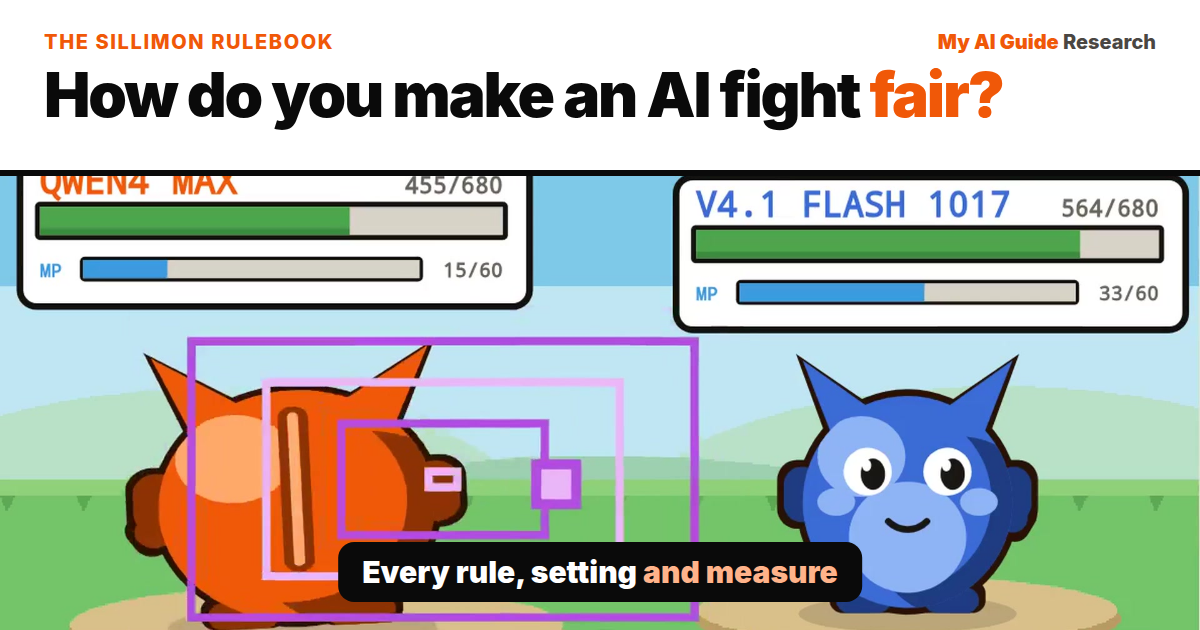
Sillimon is an original turn-based monster duel that I built to compare AI models in a real game. Two models each control an identical monster, both choose a move in secret every turn, and the game engine decides what happens, so only the decisions can win.
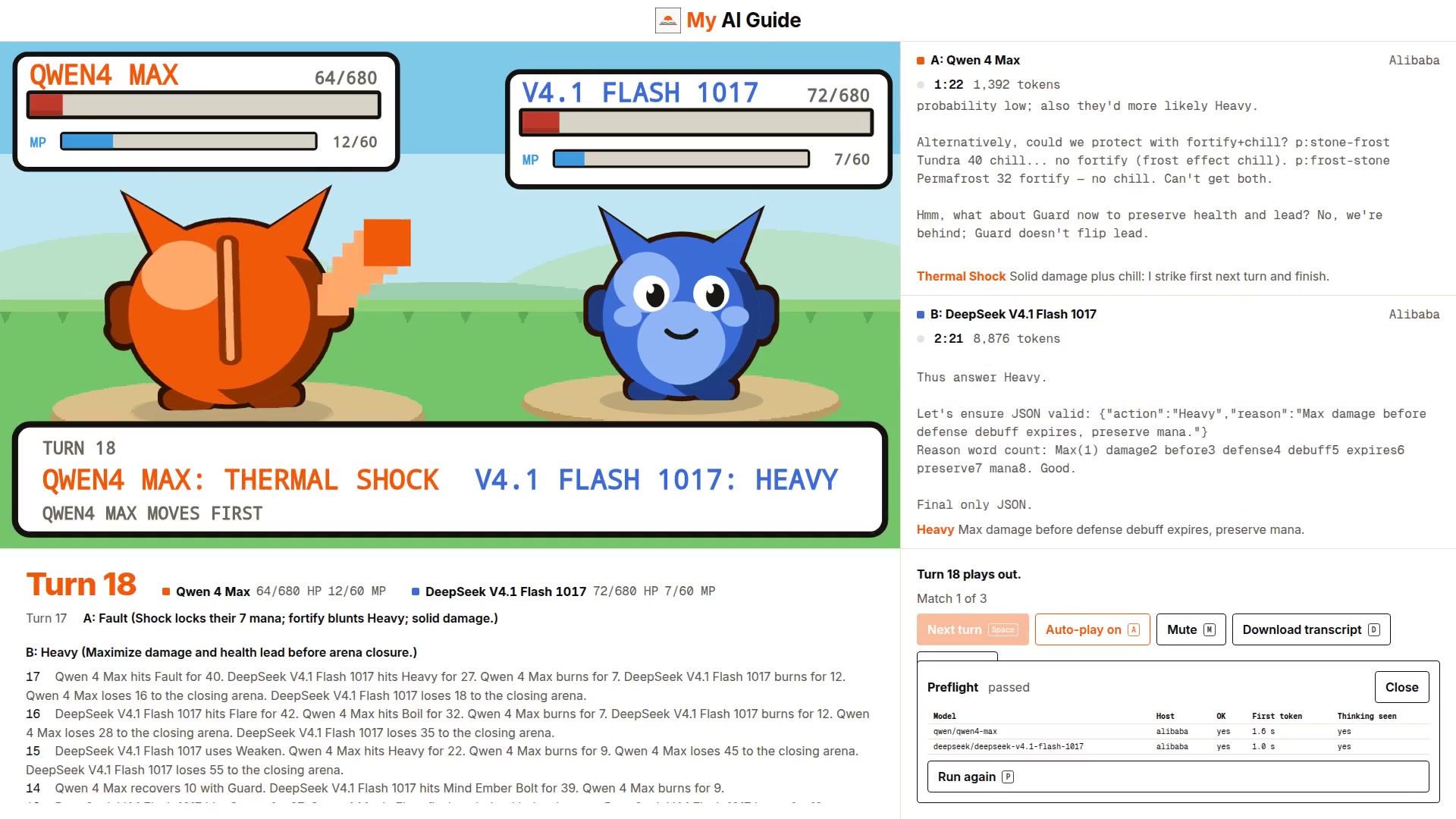
Everything in it is original. A game makes a model decide, live with the result and adapt, which is closer to the work we hand AI agents than a quiz with a fixed answer. Two fights are published so far: DeepSeek V4.1 Flash vs GLM 5.3 Flash and Qwen 4 Max vs DeepSeek V4.1 Flash.
The Fighters
Both fighters start with exactly the same numbers, so any difference in the result comes from the decisions. Mana is the energy every spell costs, and it comes back a little every turn.
| Stat | Value (both fighters) |
|---|---|
| Health | 680 |
| Mana at the start | 20 |
| Mana cap | 60 |
| Mana regained at the end of every turn | 7 |
| Attack | 20 |
| Defence | 15 |
| Speed | 10 |
Attack scales every hit a fighter lands, defence shrinks every hit it takes, and speed decides who moves first. A boost raises defence or speed (or attack) for yourself and a curse lowers them for the opponent, but never more than 30 points from the starting value.
How One Turn Works
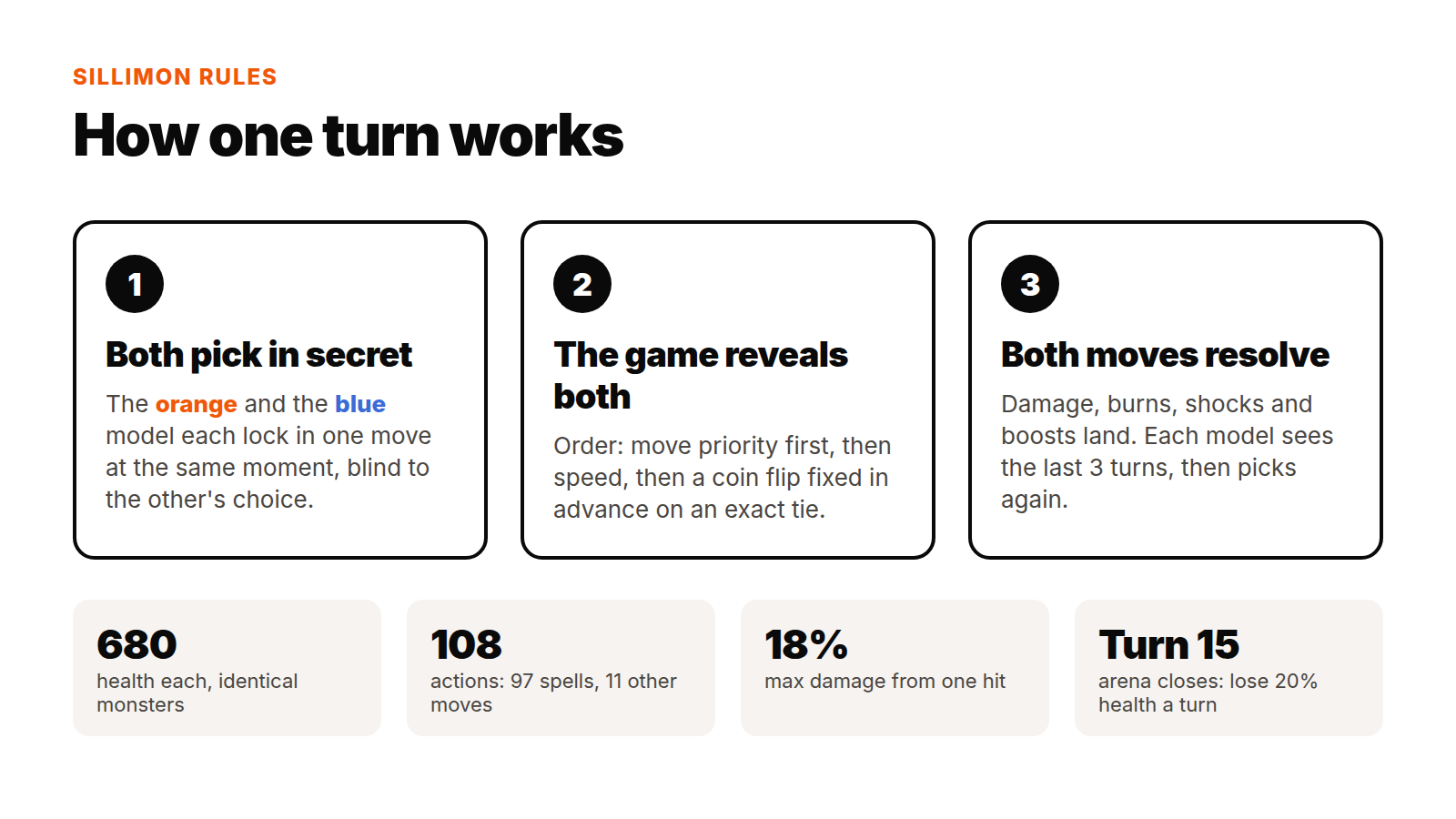
Every turn has three steps, and both models act at the same moment. That blind choice is what makes the game about reading the opponent.
- Both pick in secret. Each model receives the game as it stands and replies with one move from its list of legal moves, plus a reason of 12 words or fewer.
- The game reveals both. Moves resolve in order of move priority first (Heavy is the only move with a lower priority), then speed, then a coin flip fixed in advance on an exact tie. A Feint earns its user the first move next turn.
- Both moves resolve. Damage, healing and extra effects land, burns tick on both fighters at the same moment, mana comes back, and the next turn begins.
What Each Model Sees Every Turn
Both models get the same page of information, built by the same code, with the same fields in the same order.
- The turn number, and a warning once the arena is closing.
- Its own health, mana, attack, defence, speed and focus, and the same for the opponent.
- Every effect still running on either fighter, and every move currently blocked.
- The last 3 turns: what each fighter did, whether it hit, and how much damage or healing it caused.
- The list of legal moves, each with its mana cost, its accuracy and an estimate of its damage, counting your own focus and boosts and the opponent's current stats.
The estimate leaves out the opponent's choice this turn, such as a Guard, and nothing hidden is shown: no future dice and no coin result.
Every Move a Model Can Pick
A model chooses from up to 108 actions: 97 spells, 5 physical moves and 6 boosts and curses. Only the moves it can legally use that turn are offered.
Spells Come in Four Sizes
Spells are built from six elements. A bolt uses one element, a pair two, a triple three, and Prism uses all six.
| Size | How many | Mana cost | Base power | Extra effects |
|---|---|---|---|---|
| Bolt | 6 | 8 | 37 | Its own element's effect at 60 percent strength |
| Pair | 30 | 10 | 47 | The second element's effect at full strength |
| Triple | 60 | 18 | 84 | The second and third elements' effects at 75 percent each; no triple on the turn after a triple |
| Prism | 1 | 26 | 130 | All six effects at 50 percent each; 90 percent accuracy; once per match |
The first element of a spell sets its damage type and its accuracy. Every element after the first adds its own extra effect, so Flashburn (fire then thunder) deals fire damage with full accuracy and adds a shock.
The Six Elements
Each element has a damage multiplier, an accuracy and an extra effect it adds to a spell.
| Element | Damage | Accuracy | Extra effect at full strength | Special |
|---|---|---|---|---|
| Ember (fire) | 1.12x | 100% | Burn: 12 damage at the end of each of the next 2 turns | |
| Bolt (thunder) | 1.45x | 75% | Shock: the opponent loses 8 mana | Hardest hitter, can miss |
| Frost (ice) | 0.95x | 100% | Chill: slows the opponent, speed down 5 for 2 turns | |
| Tide (water) | 0.85x | 100% | Soak: the opponent takes 15% more from the next hit | Heals the caster 5, 9 or 12 by size; refunds 4 mana on a hit |
| Mind (psychic) | 1.00x | 100% | Mark: next turn, a spell as big as or bigger than the opponent's gets +20% | Ignores half of the defence |
| Stone (earth) | 1.02x | 100% | Fortify: your defence rises by 8 for 2 turns | Ignores a quarter of the defence |
Prism ignores a quarter of the defence too. Each extra effect also nudges a spell's power a little, from 4 percent up for a burn to 6 percent down for a fortify, so a strong effect is paid for in damage.
Physical Moves
Physical moves are free, except Guard. They give a model ways to stall, save mana or set up a big spell.
| Move | What it does | Limit |
|---|---|---|
| Jab | Small hit (power 4) plus one focus stack, up to 3, and only Jab builds focus; your next spell gets +12% per stack and uses them all | Any turn |
| Heavy | Bigger hit (power 16), but it moves after every normal move | Any turn |
| Feint | Tiny hit (power 1), and you act first next turn | Any turn |
| Guard | Costs 6 mana, halves the damage you take that whole turn and heals 10 | Twice per match |
| Stand Still | Deals no damage, gains 16 mana | Once per match |
Boosts and Curses
A boost raises your own attack, defence or speed, and a curse lowers your opponent's. Each one costs 6 mana, lasts 4 turns, and can be cast again 3 turns after it was used.
| Boost (you) | Curse (opponent) |
|---|---|
| Haste: speed +6 | Lumber: speed -6 |
| Ramp: attack +6 | Dull: attack -6 |
| Plating: defence +15 | Weaken: defence -15 |
Casting the same boost or curse again refreshes it instead of stacking it, so nobody can pile up an unbeatable stat.
How Damage Is Worked Out
Every hit follows the same three steps for both fighters, so anyone can check a fight by hand.
- Start with the move's power. A spell's power is its size's base power times its element's multiplier. A physical hit is 60 percent of the attacker's attack plus the move's power, so a Jab at starting attack is 12 plus 4.
- Apply the bonuses. A spell gains 12 percent per focus stack and scales with the caster's attack against the starting 20. Soak and mark add their share on top.
- Apply the defence. Damage is multiplied by 50 divided by 50 plus the target's defence. At the starting defence of 15, that removes about 23 percent, and Mind and Stone spells ignore part of the defence first.
Two caps then apply to every hit. All bonuses together can lift a hit to at most 1.5 times its normal size, then a Guard halves it, and finally no single hit can take more than 18 percent of maximum health, which is about 122.
Those caps mean the big swings come from planning: stacking focus, timing a mark or draining mana.
The Rules Every Model Must Follow
Both models are told these rules, and the game engine enforces them, so no model wins by repeating one strong move.
What a model must work within:
- Each spell needs a different spell, or any other action, between two casts of it, at every size.
- After any triple, the next turn needs something other than a triple.
- Prism works once per match.
- Guard works twice per match and Stand Still once, and then they leave the list.
- Every spell, curse and Guard is paid for in mana, and only affordable moves are offered.
What the game always does:
- A spell with accuracy under 100 percent can miss, and a miss still costs the mana.
- A spell or curse is paid for when it resolves. If a faster shock drains the mana below its cost first, it fizzles: the move is wasted and the mana that is left stays. Guard is paid the moment it is chosen, so a shock leaves it in place.
- From turn 15 the arena closes: each fighter loses 20 percent of its current health at the end of every turn. This loss cannot be blocked or healed, and the fighter with more health always lasts longer, so the arena finishes the fight and keeps the lead where it is.
- The fight ends only when a health bar reaches zero. If both reach zero at the same moment, the fighter that dealt more damage across the match wins, and further tiebreaks by health and turn order mean every fight has a winner.
What a model must send back:
- A short JSON reply (a fixed text format software can read) holding one move from the legal list and a reason of 12 words or fewer.
- An empty, cut-off or illegal answer is never re-asked. That turn is played as a Jab and the illegal answer is counted in the results.
How I Keep It Fair
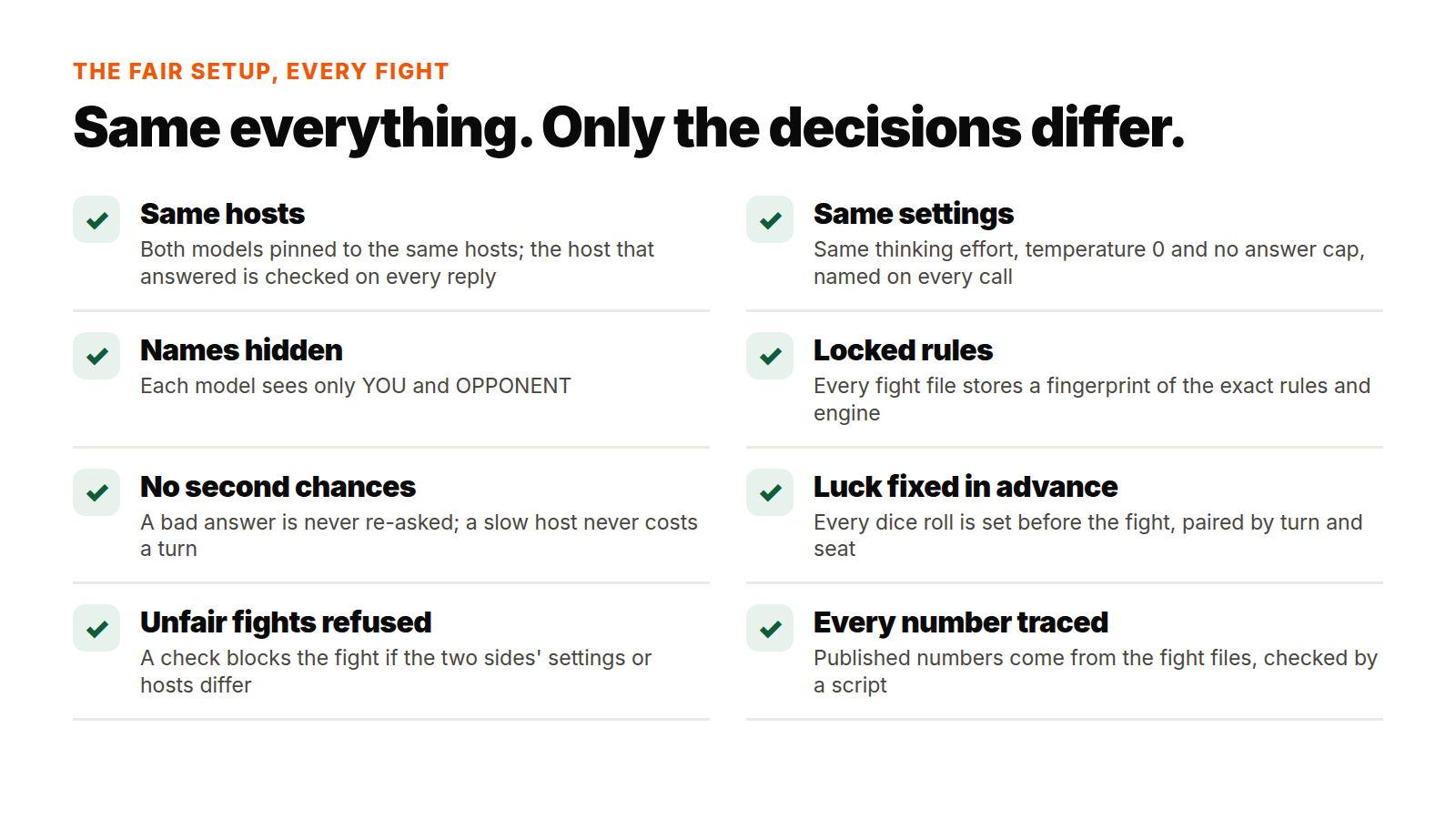
Every fairness rule is enforced in code, so it holds in every fight.
The Same Game for Both
- Identical fighters. Same stats and the same spellbook for both.
- Identical instructions. Both models get the same rules, built by the same code. Every number in the rules is read from the game engine, so the text always matches the real game.
- Hidden names. Each model only sees "YOU" and "OPPONENT", so no model can favour itself or react to a famous rival.
- Locked rules. Every fight file stores a fingerprint of the exact engine and rules text, and both published fights carry the same one.
The Same Model Setup for Both
I reach every model through OpenRouter, a service that gives one API (a way for software to talk to a model) for hundreds of AI models. One model can be served by several companies, called hosts, and each may run it differently.
- Same hosts. Both models are pinned to the same hosts in the same order, which means OpenRouter may only send their calls to those companies. The host that answered is read from every reply, and an answer from any other host is thrown away and never counts.
- Same precision. Precision is how exactly the model's numbers are stored, for example fp8, which uses 8-bit numbers. Fewer bits make a smaller, cheaper and slightly rougher copy of the model. Where the hosts publish it, both models run at the same one (fp8 in the first fight); where a host leaves it unpublished, as Alibaba did in the second fight, both models run on that one host and the article says so.
- Same settings. Both models get the same thinking effort (how hard the model is asked to think, from minimal to high), which I send through OpenRouter's reasoning setting on every call: high in both published fights. Both get temperature 0 (the setting that controls how random answers are; 0 is the least random), no cap on answer length and no instruction about speed.
One Try for the Model, Extra Tries for the Network
A model's own bad answer is never re-asked. A slow or broken host is the network's fault, so it never costs the model a turn.
- A host error gets up to three more tries, after waits of 3, 8 and 20 seconds.
- A reply that breaks off part way through gets one more try on the same host.
- Each call has a 10-minute clock. A model still working when it runs out is asked again, on the next pinned host when there is one.
- Every retry is written into the fight file.
Luck Fixed in Advance
Only two things in Sillimon are left to chance: whether a spell under 100 percent accuracy hits, and the coin on an exact speed tie. Every one of those dice is fixed before the fight starts, worked out from the game's seed (a starting number chosen before the fight), the turn and the seat.
That pairing means a rematch with the seats swapped deals each model exactly the dice its rival met, so luck cancels out over the pair. Nobody can retry or steer a dice roll during a fight.
Seats, Timing and Checks Before Any Fight
- Two seat plans. The default is a best of three where the second game swaps the seats on the same dice. The other plan keeps each model in its own seat for three games on three different sets of dice. Every article says which plan it used; both published fights so far used this second plan.
- The same moment. In both published fights, all three games ran at the same time, each on its own cloud server, so both models met the same time of day on the same hosts.
- A fairness check that refuses to start. Before any fight, a check refuses it if the thinking effort or temperature differ, the hosts are not pinned, a host's published precision differs between the models, or the seat plan is not one of the two above.
- The game is tested first. Before any AI model plays, the rules pass 46 automated balance checks with scripted players: the same player wins about equally often from either seat, every fight is a knockout between turn 10 and turn 20, no hit passes the cap, and every rule works as written. A 1,000-match audit and 11 checks of the winner logic run too.
I learned why this matters the hard way. My first DeepSeek against GLM series had one model unpinned and served mostly at a lower precision, so I threw that series away and ran it again with every safeguard above.
How I Measure a Fight
Every call is saved in the fight file with what the game did with the answer, so every number comes straight from the file. For every move, the file holds the move chosen, the model's short reason, the host that answered, the time from question to answer, the tokens it wrote and what the call cost. A token is a small piece of text, roughly three quarters of a word, and for a thinking model (one that writes private reasoning before it answers) the file splits out the thinking tokens.
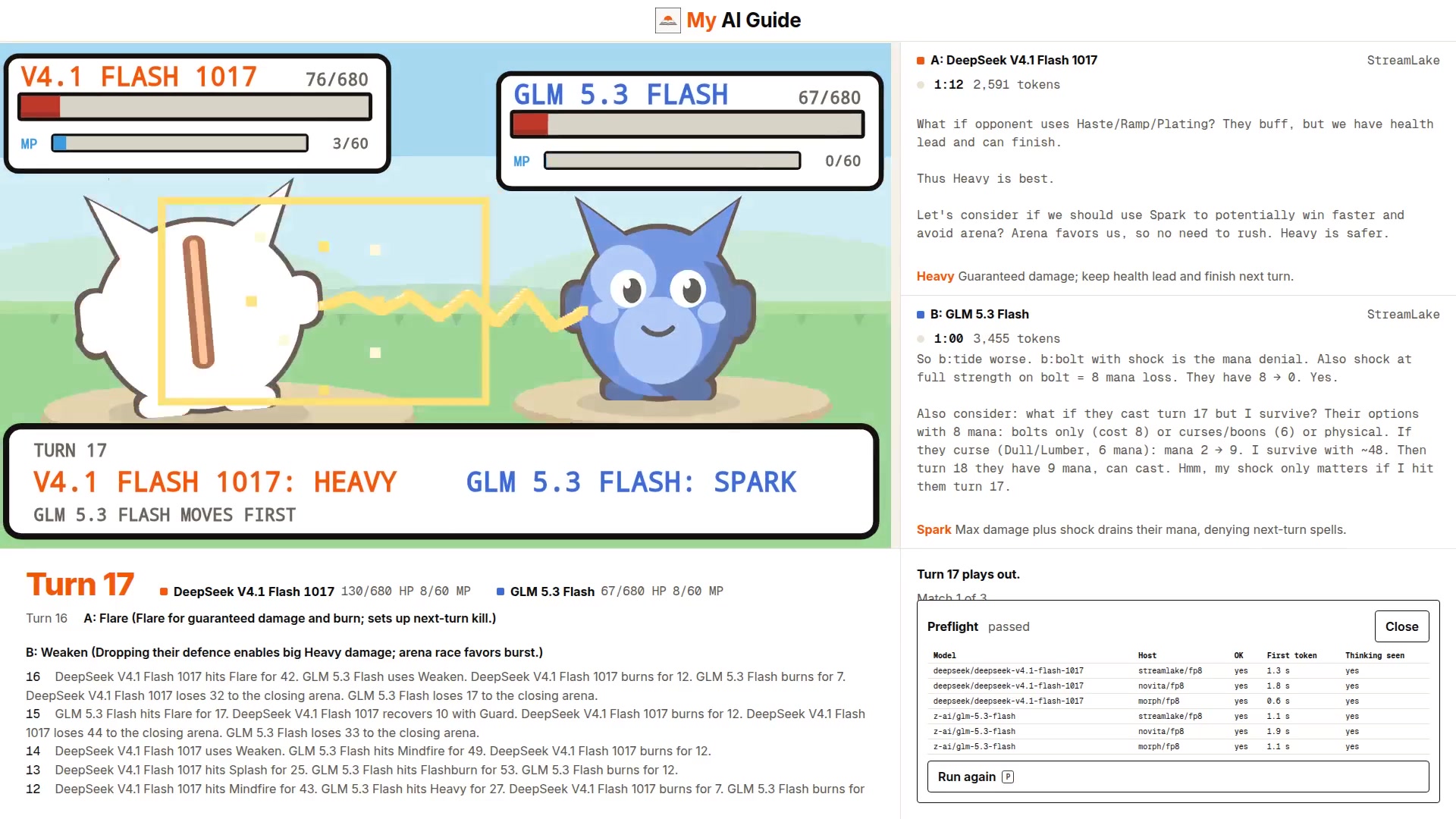
From those files, one script works out every number an article uses:
| Measure | How it is counted |
|---|---|
| Result | The winner, the turn it ended and the health left |
| Damage dealt | Every point of damage each fighter caused, burns included |
| Spells cast | Every spell a fighter cast, hit or miss |
| Misses | Spells under 100 percent accuracy whose dice roll failed |
| Fizzles | Spells wasted because a shock drained the mana first |
| Legal moves | Answers that were a legal move, out of all answers |
| Thinking per move | Thinking tokens divided by moves, per model |
| Time per move | The average and the longest wait for an answer |
| Cost | The price OpenRouter billed for each call, added up per game and per model |
| Cost per 1,000 moves | Total cost divided by moves, times 1,000, the number a builder can plan with |
Each fight article reports these numbers; the six published games so far all ended between turn 18 and turn 20. The script writes the numbers to a facts file for each study. Before an article goes live, a check reads every number in it and blocks any number it cannot find in that file, at the precision it is written.
After every fight, two more checks run over the files: one replays every move against the rules and lists every illegal answer, and one decides the winner again with the same winner logic. Both published fights pass both checks.
What I Am Testing Next
Sillimon is a living test, and each of these could move a result.
- Seat swaps: a series that swaps seats on the same dice, so each model plays both sides.
- More games: more games per pair, to turn a matchup into a ranking.
- Thinking effort: rematches at low and medium effort, to see how cost and results move.
- History length: showing more than the last 3 turns, which may help some models more than others.
- Arena timing: an earlier or later close, which changes how much a fight rewards planning.
If you think a rule favours one model, or have an idea that makes the game fairer, send it through the My AI Guide contact page starting with "Sillimon rule". I read every suggestion, and each rule change will be listed here with its date so earlier results stay comparable.
Frequently Asked Questions
The questions people ask most, each answered on its own.
What is Sillimon?
Sillimon is an original turn-based monster duel I built to test AI models in a real game. Two models control identical monsters with 680 health and the same 97 spells, pick a move in secret every turn, and the engine resolves both, so only decisions decide the winner.
Can a model just repeat its strongest spell?
The rules make variety win. The same spell needs a different move between two casts, a triple cannot follow a triple, Prism works once per match, and mana returns only 7 per turn. A model that leans on one move runs short of mana or options quickly.
What happens if a model gives an illegal answer?
An illegal, empty or cut-off answer is never re-asked. That turn is played as a Jab, a small hit, and the miss is recorded in the results. A slow or broken host never costs the model a turn: the call is retried, and every retry is logged.
How is luck kept fair?
Only spell accuracy and the coin on an exact speed tie involve chance, and every one of those dice is fixed before the fight from the game's seed, the turn and the seat. A rematch with the seats swapped deals each model its rival's dice, so luck cancels out.
How do you measure cost and thinking?
Every call is saved with the tokens the model wrote, its thinking tokens and the price OpenRouter billed. A script adds these up per game and per model, then works out thinking per move, time per move and cost per 1,000 moves, and a check blocks any number missing from those records.
Can I suggest a rule change?
Yes. Send it through the My AI Guide contact page and start the message with "Sillimon rule". I read every suggestion, changes that improve fairness go into the next version of the rules, and each change is listed on this page with its date so earlier results stay comparable.
Sources
- The Sillimon game engine and rules text (version 7).
- OpenRouter provider routing documentation
- OpenRouter reasoning tokens documentation
- DeepSeek V4.1 Flash vs GLM 5.3 Flash
- Qwen 4 Max vs DeepSeek V4.1 Flash
Want the next Sillimon fight first? Subscribe to the My AI Guide newsletter for a weekly digest of AI tool tests and comparisons.
This research may mention tools with affiliate links. If you buy through them, we may earn a commission at no extra cost to you.